

Granite has a reputation for being tough, and that reputation causes most of the damage. Because the stone itself is hard, people reach for whatever is under the sink: vinegar, bleach, a degreaser, a scouring pad. The granite shrugs it off for a while. Then the polish goes flat, the grout turns chalky, and a coffee spill that used to wipe away leaves a dark ring.
Knowing how to clean granite tiles safely comes down to protecting two things: the stone surface and the sealer that sits in its pores. This guide covers what to use, what to avoid, a step-by-step method for granite flooring, how to deal with stains, and how often to clean and reseal. It is written from the point of view of a hard-surface restoration team that works on natural stone in Melbourne homes, cafes and outdoor areas every week.
Quick Answer: How to Clean Granite Tiles Safely
Definition: Safe granite tile cleaning means removing dirt and spills with a pH-neutral cleaner, soft tools and plenty of drying, while avoiding acids, bleach, ammonia and abrasives that dull the polish, strip the sealer or erode the grout between the tiles.
Short answer: Sweep or dust mop the floor, damp mop with a pH-neutral stone cleaner diluted in warm water, rinse with clean water, and dry with a microfibre cloth or mop. Wipe spills straight away, and test the sealer once a year.
The essentials:
- Use a cleaner labelled pH-neutral or safe for natural stone.
- Never use vinegar, lemon juice, bleach, ammonia or abrasive powders.
- Use a microfibre mop or soft cloth, never steel wool or stiff brushes.
- Blot spills instead of wiping, so they do not spread.
- Dry the floor after mopping to prevent streaks and water spots.
- Check the sealer with a water drop test and reseal when water soaks in.
Step by step:
- Remove loose grit with a dust mop or soft-bristle broom.
- Mix a pH-neutral stone cleaner with warm water as directed on the label.
- Damp mop in sections with a microfibre pad, not a soaking wet mop.
- Rinse the floor with a second mop and clean water.
- Dry with a clean microfibre cloth or dry mop.
- Treat any stains separately with a poultice rather than harsher cleaners.
What Does “Safe” Granite Tile Cleaning Actually Mean?

Granite is an igneous rock, formed when magma cools slowly underground. That slow cooling creates a dense, interlocking crystal structure, which is why granite resists scratching and heat better than marble or travertine. It is one of the most durable stones you can put on a floor.
Durable does not mean immune. Granite is a natural stone, and natural stone has microscopic pores. How porous it is depends on the variety. Some dark, dense granites absorb almost nothing, while lighter and more coarsely grained varieties soak up liquids far more readily. Stone suppliers and care guides, including the guidance published by the Natural Stone Institute, treat the sealer’s condition as the real indicator of how protected a surface is, not the stone’s reputation.
Why granite tiles need more care than a solid slab
A granite benchtop is a single slab. A granite floor is dozens or hundreds of tiles joined by grout, and the grout is the weak point. Cement-based grout is porous, it reacts to acidic cleaners, and it is where dirt, mould and stains settle first. When people ask how to clean granite flooring without damage, the grout line is usually where the damage starts.
Polished, honed and flamed finishes
The finish on your tiles changes how they show wear and how they should be cleaned.
| Finish | What it looks like | Cleaning notes |
| Polished | Glossy, reflective | Shows streaks, etching and dull patches easily. Always dry after mopping. |
| Honed | Matte, smooth | Hides scratches better but shows oily marks and can hold dirt in the surface. |
| Flamed or textured | Rough, non-slip, common outdoors | Traps dirt in the texture. Needs a soft-bristle brush rather than just a mop. |
Why Cleaning Granite Tiles the Right Way Matters

Granite tiles are a long-term investment, and the cost of getting the routine wrong is rarely obvious on day one. It shows up over a year or two as slow, cumulative wear.
Benefits of a safe cleaning routine
- The sealer lasts longer. Acidic and highly alkaline products break down the sealer faster, which means more frequent resealing. Neutral cleaners leave it intact.
- The finish stays consistent. Polish dulls in patches when the wrong chemicals or abrasive pads are used, and that cannot be fixed with a mop.
- Stains stay on the surface. A working sealer gives you time to wipe up a spill before it soaks in.
- Grout stays sound. Gentle cleaning stops grout from eroding, crumbling or discolouring.
- The floor is safer to walk on. Soap film and cleaner residue make polished stone slippery. A rinse and dry step removes it.
- It costs less over time. Restoration, regrouting and re-polishing are far more expensive than a good weekly routine.
Common Mistakes That Damage Granite Tiles

Most granite problems we see in Melbourne homes trace back to the same handful of habits.
Using vinegar, lemon or other acids
Vinegar is the most common recommendation online and the most common cause of dull granite floors. Acid attacks the sealer, and it eats into cement grout. Granite itself is more acid-resistant than marble, but the system as a whole (stone, sealer and grout) is not. Use of acidic cleaners is the one habit that the Natural Stone Institute and most stone care suppliers consistently warn against.
Reaching for bleach, ammonia or all-purpose sprays
Chlorine bleach and ammonia-based sprays are strongly alkaline. They can strip sealer, lighten grout unevenly, and leave a residue that attracts dirt. Bleach also does nothing to an oil stain except bleach the colour around it.
Scrubbing with abrasive pads or powders
Scouring pads, cream cleansers and steel wool scratch polished surfaces. Fine scratches scatter light and make the area look cloudy, and the only fix is professional honing and re-polishing.
Leaving the floor wet
Air-drying leaves water spots and mineral film on polished granite. Leaving puddles near grout lines pushes moisture into the joints.
Using too much cleaner
More product does not mean a cleaner floor. Over-concentrated cleaner leaves a sticky film that holds dirt and makes the floor slippery. Follow the dilution on the label.
Skipping the daily dry sweep
Grit tracked in from the street is the main thing that scratches stone. A dust mop takes two minutes and does more for the finish than any product.
Ignoring the sealer
Many people clean carefully for years without ever checking whether the sealer is still working. By the time a stain appears, the protection is already gone.
What You Need Before You Start
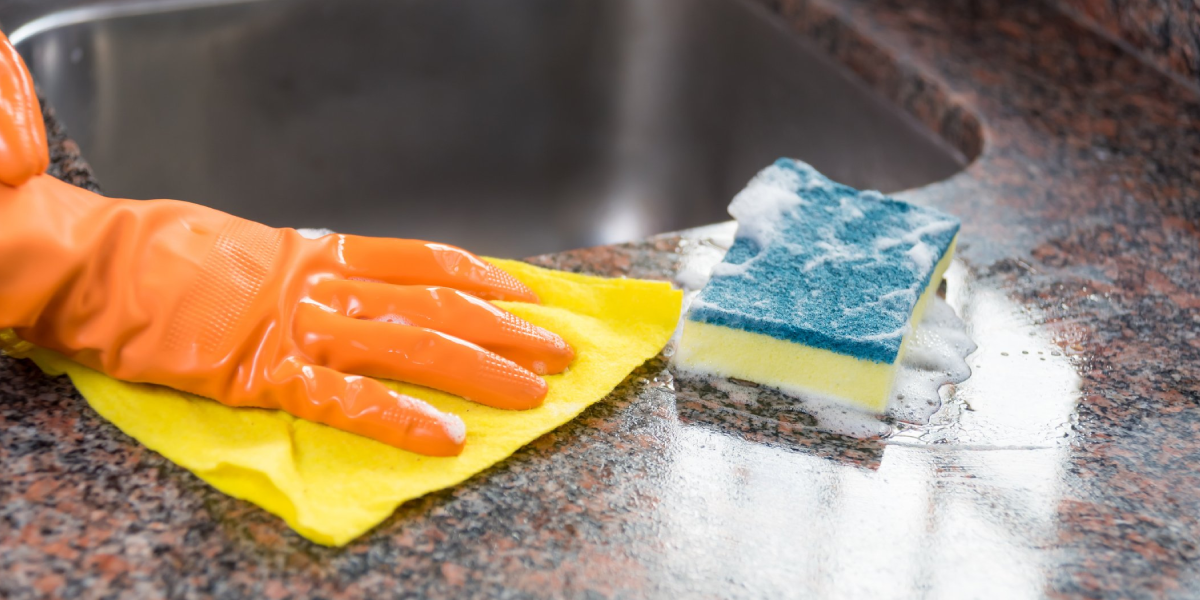
- A dust mop or soft-bristle broom
- A pH-neutral stone cleaner (or a few drops of mild dish soap in warm water for light cleans)
- Two buckets: one for cleaning solution, one for rinse water
- Microfibre mops or cloths, with spare pads you can swap out
- A soft nylon brush or old toothbrush for grout lines and textured finishes
- Clean, dry towels for drying
Test any new product on a spare tile or a hidden corner before using it across the floor. Granite varieties differ, and a two-minute test costs nothing.
How to Clean Granite Tiles: A Step-by-Step Process
This is the routine we recommend for how to clean granite floors in a typical home. It takes about 30 to 45 minutes for an average room.
Step 1: Clear the surface and remove loose grit
Move rugs and furniture. Use a dust mop, soft-bristle broom or a vacuum with a soft floor head. Avoid vacuums with a hard rotating brush or worn plastic wheels, which can scratch polished stone. Grit is abrasive, so mopping over it just drags it across the surface.
Step 2: Mix your cleaning solution
Fill one bucket with warm water (not hot) and add a pH-neutral stone cleaner at the dilution shown on the label. Fill the second bucket with plain warm water for rinsing. Hot water is not necessary and can stress grout joints over repeated cleans.
Step 3: Mop in small sections
Dip a microfibre mop, wring it until it is damp rather than dripping, and work across a section of about two square metres. Let the cleaner sit for a minute or two on dirtier areas, as the manufacturer directs, so it can loosen grime without you needing to scrub.
Step 4: Agitate grout lines and textured areas gently
For grout lines, flamed finishes and outdoor granite pavers, use a soft nylon brush with the same cleaner. Never use a wire brush. It scratches the tile edges and tears up the grout surface.
Step 5: Rinse thoroughly
Go over the area again with a clean mop dipped in the rinse bucket. This removes the residue that causes streaks and slippery film. Change the rinse water as soon as it looks cloudy.
Step 6: Dry the floor
Dry with a clean microfibre mop or towels. On polished granite, this is what delivers the streak-free finish. Keep foot traffic off the floor until it is dry, since wet stone can be slippery.
Step 7: Spot-treat anything that remains
If stains are left after a normal clean, do not escalate to stronger cleaners. Use the poultice methods in the stain section below.
Best Cleaner for Granite Tiles and Flooring

The best cleaner for granite tiles is a pH-neutral stone cleaner. Stone care manufacturers consistently advise looking for the words “pH neutral” or “safe for natural stone” on the label. The LATICRETE stone cleaning guide recommends a neutral, pH-balanced cleaner formulated for stone for regular maintenance.
| Cleaner | Safe for granite tiles? | Notes |
| pH-neutral stone cleaner | Yes (recommended) | Made for natural stone, leaves little residue, protects the sealer. |
| Warm water and mild dish soap | Yes, for light cleans | Use only a few drops, and rinse well so soap film does not build up. |
| Plain warm water and microfibre | Yes | Good for dust and light daily marks. |
| Vinegar or lemon juice | No | Acidic. Strips sealer and damages cement grout. |
| Bleach | No | Alkaline, can discolour grout and break down sealer. |
| Ammonia-based glass or multipurpose sprays | No | Leave residue and can dull polished surfaces. |
| Scouring powders and abrasive pads | No | Scratch polished and honed finishes. |
| Steam mops | Use with caution | Heat and moisture can stress grout and sealer. Check with your tiler or sealer manufacturer first. |
Can you use vinegar to clean granite tiles?
No. A one-off wipe will not ruin a floor, but regular use steadily degrades the sealer and roughens the grout. Choose a stone-safe cleaner instead.
How to Remove Stains from Granite Tiles

Stains fall into a few categories, and the right treatment depends on what caused the mark. Identify the stain first, because the wrong treatment can set it permanently.
| Stain type | Common causes | Treatment |
| Oil-based | Cooking oil, grease, cosmetics, lotion | Poultice of baking soda and water. Stone-care professionals sometimes use acetone or mineral spirits as the solvent. |
| Organic (water-based) | Coffee, tea, wine, juice | Poultice of baking soda and hydrogen peroxide. |
| Rust | Metal furniture legs, pot stands, outdoor fixtures | A rust remover made specifically for natural stone. Hardware-store rust removers often contain acids. |
| Water spots and rings | Moisture sitting on the surface | Dry buffing with a soft cloth. If the ring is dark, the stone has absorbed water and the sealer needs checking. |
How to make and apply a poultice
A poultice is a paste of an absorbent powder and a liquid that draws the stain out of the stone as it dries. The Natural Stone Institute and stone care suppliers describe the same basic method.
- Wipe the area clean with a pH-neutral cleaner and let it dry.
- Mix baking soda with water (oil stains) or a small amount of hydrogen peroxide (organic stains) until it reaches a thick, peanut-butter consistency.
- Spread the paste about 5 to 6 millimetres thick over the stain, slightly beyond its edges.
- Cover with plastic wrap and tape down the edges.
- Leave it for 24 hours, or up to 48 hours for older stains.
- Remove the plastic, let the paste dry, then wipe it away with a damp cloth and dry the area.
- Repeat if needed. Deep or old stains can take several applications.
If you use acetone or any solvent, ventilate the room, keep it away from flames and test a hidden area first. For hydrogen peroxide on lighter-coloured granite, test a small spot before treating a visible one.
If a stain appeared easily, that is a sign the sealer is worn. Do the water test below and reseal after the stain is gone and the stone is fully dry.
How to Maintain Granite Tiles Long Term

Maintenance is where most of the value is. A consistent routine takes less time than occasional heavy cleaning, and it keeps the floor looking good for years.
Cleaning schedule
| Frequency | Task |
| Daily or every few days | Dust mop or soft sweep. Wipe up spills immediately. |
| Weekly | Damp mop with pH-neutral cleaner, rinse and dry. |
| Monthly | Check grout lines and high-traffic paths, and spot-clean entryways. |
| Yearly | Run the water drop test. Deep clean grout if it looks discoloured. |
| Every 1 to 3 years (as needed) | Reseal when the test shows the sealer is no longer working. |
How often should granite tiles be cleaned?
Sweep or dust mop as often as you can, and damp mop weekly. Busy kitchens, entryways and homes with pets or children may need a damp mop two or three times a week. Outdoor granite pavers can usually go longer between cleans, but they collect leaf stains, algae and dirt, so check them each season.
The water drop test
This is the standard way to check whether your sealer is still working.
- Clean and dry a small area, preferably a high-traffic spot.
- Place a few drops of water on the tile.
- Wait 10 to 15 minutes.
- If the water beads up and the stone stays the same colour, the sealer is working. If the stone darkens or the water soaks in, it is time to reseal.
Do the same on a grout line, because grout absorbs water faster than the stone and often needs sealing first. Some very dense, dark granites barely absorb anything and may not need sealing at all, so test before spending money on a sealer.
Choosing a sealer
Use a penetrating (impregnating) sealer designed for natural stone, with both water and oil resistance. Topical coatings sit on the surface, tend to wear unevenly and can leave a film that makes the floor look cloudy. Always strip, clean and fully dry the floor before sealing, since moisture trapped in the pores gives a patchy result. If your tiles are laid with grout, ask about a grout sealer as well. Our grout sealing service covers this for Melbourne homes.
Real-World Examples from Melbourne Homes
The following are composite scenarios based on the kinds of jobs we see regularly, not individual client case studies.
The dull kitchen floor
A homeowner used a vinegar and water mix weekly for several years. The granite tiles looked flat, and the grout had become pale and sandy. The sealer had worn off entirely. The fix was a deep clean with a stone-safe cleaner, grout restoration and a fresh coat of penetrating sealer. Switching to a neutral cleaner stopped it from recurring.
The oil stain near the stove
Cooking oil had dripped near the cooktop and soaked into a few tiles, leaving dark patches. A baking soda poultice, applied twice over 48 hours, lifted most of the mark. The tiles were then resealed, because the stain had gone in easily and showed the sealer was no longer doing its job.
The outdoor granite paving
A courtyard in Melbourne’s south-east had grey-green patches from algae and shade. Pressure washing at high settings would have damaged the grout, so the job used a low-pressure clean with a stone-safe treatment and a soft brush, followed by sealing. Outdoor stone often needs a regular check because of rain, leaf litter and shade.
Expert Tips for Cleaning Granite Tiles
- Use entry mats. Mats inside and outside doorways catch most of the grit before it reaches the stone.
- Use felt pads on furniture. Chair legs dragged across polished granite leave scratches.
- Change mop pads often. A dirty pad spreads soil instead of removing it.
- Blot, do not wipe. Wiping a fresh spill spreads it. Blot first, then clean the area.
- Avoid wax and oil-based polishes. They build up and attract dirt on granite floors.
- Keep notes. Record when you last tested and sealed the floor so the schedule is based on your records, not guesswork.
- Be careful with composite stone. Products sold as granite can be agglomerate, which is granite particles bound with resin. Check the care instructions from your supplier.
When to Call a Professional Tile Cleaner
A good routine handles most day-to-day cleaning, but some problems need professional equipment and experience:
- Grout that is deeply stained or crumbling
- Stains that return after repeated poultice treatments
- Dull or etched polished tiles that need honing or restoration
- Old sealer that needs stripping before a new coat goes on
- Large floors, outdoor paving or commercial spaces
- Tiles that look uneven or blotchy after a DIY attempt
Our team works on a range of surfaces beyond granite, including sandstone, ceramic tiles and porcelain, as well as travertine, slate, marble and outdoor tiles.
Frequently Asked Questions About Cleaning Granite Tiles
What is the safest way to clean granite tiles?
The safest method is to dust mop or sweep first, then damp mop with a pH-neutral stone cleaner in warm water, rinse with clean water and dry with a microfibre cloth. Avoid acids, bleach, ammonia and abrasive pads, and wipe spills as soon as they happen.
What cleaner is best for granite flooring?
A pH-neutral cleaner made for natural stone is the best choice. It cleans without breaking down the sealer or damaging grout. For light cleaning, a few drops of mild dish soap in warm water also works, as long as you rinse well afterwards.
Can you use vinegar to clean granite tiles?
You should not. Vinegar is acidic, and repeated use strips sealer and attacks the grout between the tiles. Even though granite is harder than marble, the surrounding system is still vulnerable. Use a pH-neutral stone cleaner instead.
How do you remove stains from granite tiles?
Identify the stain type first. Oil-based stains usually respond to a baking soda and water poultice. Organic stains such as coffee or wine respond to baking soda mixed with hydrogen peroxide. Cover the paste with plastic wrap, leave it for 24 to 48 hours, then wipe away. Rust needs a stone-specific rust remover. If stains keep returning, the sealer may need replacing.
How often should granite tiles be cleaned?
Sweep or dust mop frequently, damp mop weekly, and wipe spills straight away. Test the sealer once a year and reseal when water soaks in, which is typically every one to three years depending on the stone, location and use.
Conclusion: Clean Granite Tiles Safely and They Will Last
Learning how to clean granite tiles safely is mostly a matter of restraint. Use a pH-neutral cleaner, soft tools and a good rinse and dry. Keep acids, bleach and abrasives away from the floor, deal with spills quickly and check your sealer once a year. That simple routine protects the polish, keeps grout intact and makes stains far easier to manage.
If your granite tiles are already dull, stained or showing worn grout, a professional clean and reseal can bring them back without harming the stone. Contact Tile Cleaners to arrange a free estimate for your Melbourne home or business.

Leave A Comment